
On this page
Full-arch dentistry has a numbers question at its heart: how many implants should carry a complete set of fixed teeth? The internet answers with certainty in both directions — four is genius, six is safer — and both certainties are wrong, because the true answer is printed inside your jaw. Here is the comparison as clinicians actually weigh it.
What both treatments share
Both replace a failing or missing dentition with a fixed bridge on implants: no denture adhesive, no palate coverage, near-natural chewing. Both are staged — implants and a temporary bridge first, then the definitive prosthesis after 3–6 months of osseointegration. Both live or die by the same three factors: planning on good imaging, honest stability measurement at surgery, and your hygiene afterwards. Neither is a luxury tier of the other; they are two engineering answers to different anatomical questions.
The case for four
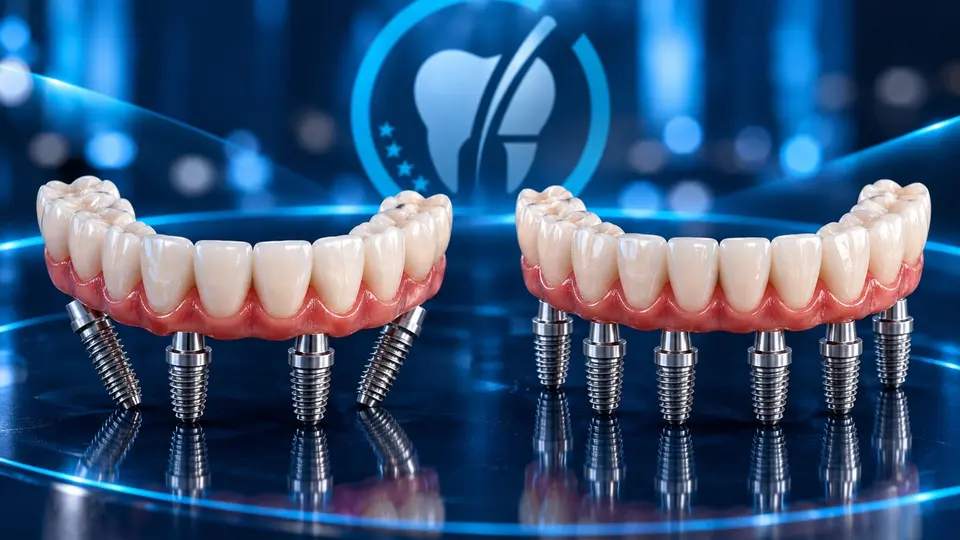
The All-on-4 concept solved a real problem: the back of the jaw is where bone disappears first — sinus expansion above, nerve position below — and where grafting is most demanding. By angling the two rear implants forward into denser bone, All-on-4 anchors a full arch while avoiding the very regions that make implant surgery complicated. Fewer surgical sites, often no grafting, and decades of published clinical use. For patients with moderate bone loss — the typical long-term denture wearer — it is frequently the only fixed option that does not begin with months of bone reconstruction.
The case for six
Six implants shorten the unsupported spans of the bridge and spread chewing force across more anchors. Mechanically that means less flex, less stress per implant, and redundancy: the failure of a single implant is less consequential to the whole design. For patients with generous bone volume — and especially heavy bites or grinding habits — six well-placed implants are robust engineering. The two extra implants add cost and two surgical sites, which is a fair price for that margin when the anatomy genuinely supports it.
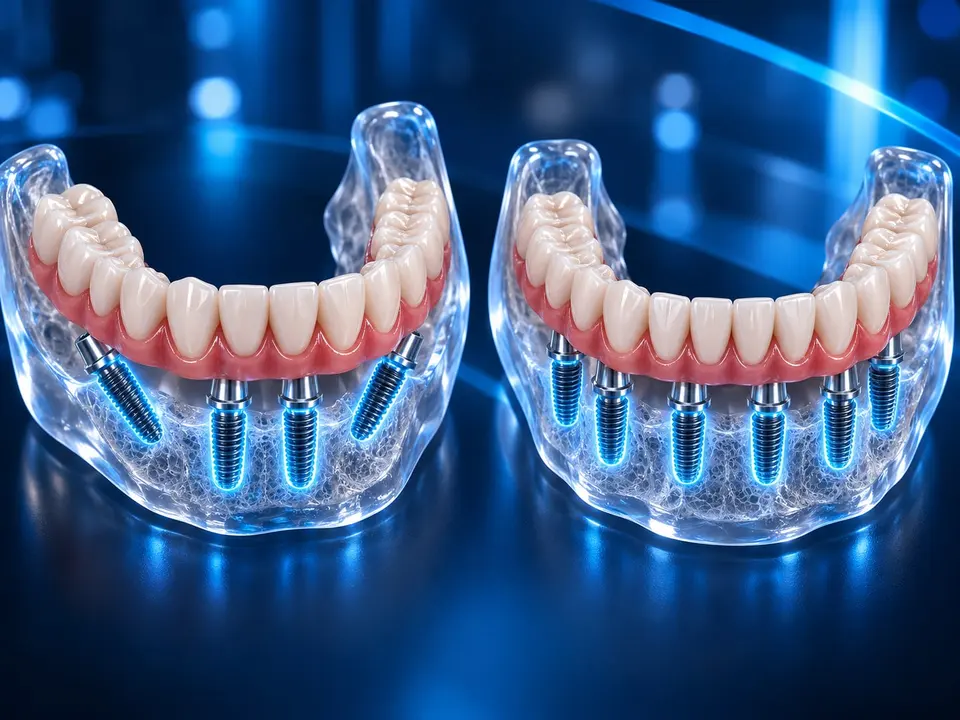
Where each goes wrong
All-on-4 goes wrong when it is over-sold to patients with ample bone and extreme bite forces who would benefit from more support. All-on-6 goes wrong more often — when clinics force six implants into jaws without the bone for them, adding grafts, cost and surgical complexity to hit a number the marketing promised. Four implants placed in the right bone beat six implants placed in hope, every time.
Four implants placed in the right bone beat six implants placed in hope, every time.
The comparison in one honest table
- Bone required: All-on-4 works with moderate loss; All-on-6 needs more volume.
- Load distribution: six spreads force wider; four remains clinically proven for typical function.
- Redundancy: six carries more spare capacity; four concentrates more on each anchor.
- Surgery: four sites versus six; both usually one surgical stage.
- Cost: six costs more — two extra implants and connectors, itemised in any honest quote.
- Timeline: identical — temporary bridge first, definitive prosthesis after healing.
How the decision is actually made
A panoramic X-ray (and where needed, further imaging) maps your bone height and density arch by arch. Bite force, grinding history, opposing dentition and prosthesis material enter the equation. Then the honest clinic quotes what your anatomy supports — sometimes four, sometimes six, sometimes four below and six above. At our clinic both configurations are quoted where both are viable, with the reasoning written down, because a patient who understands the why makes better decisions and better recoveries.